Getting started
Company Verification Process
Regulations of the Trans.eu Platform
Contact Trans.eu
How to get access to TFC/TFF and CargoON
Trans.eu Pricing Update 2026 – FAQ
Product plan
How to submit a termination notice on the Trans.eu Platform
How to Pay an Invoice Issued in EUR
Basic information
Company account
Employee accounts
Logging into the account
TransID
Overview of modules for Forwarders
Overview of modules for Carriers
Overview of modules for Shippers
Messenger
Messenger functions
Messenger settings
Contact groups in the Messenger
Negotiation and acceptance of offers in the messenger - forwarders (TFF) and CargoON
Negotiations and acceptance of offers in the Messenger by the Carrier
Information in the chat window that the caller is on the debt exchange
Conversation archive
Decision panel
Decisions to be made module
Decisions to make - confirmation of the transaction
Decisions in the Panel - Accepting a route
Freights
Management of sent freights
The freight archive
Payment term for a freight
Import of freights from a CSV file
Freight templates
Multifreight - handling the function by the contractor
Multifreight - handling the function by the carrier
Forms of freight settlement
Bulk actions on freights
Limited quantity
Creating a freight offer for bulk materials
Freight Negotiation Management - Principal
Quick Filling - how to use automatic freight creation
Internal negotiations in the company publishing the freight
Loads exchange
Block direct offers from selected users
Add a freight offer
Delete freight offers
Searching for offers on the freight exchange
Filter load offers
Editing filters
Search for freight offers on the map
Cost calculation on the Load exchange
Alerts before entering into cooperation
Pop-up menu in the exchange offer table
Offers received from a private exchange
Private freight exchange for forwarders
Humanitarian aid
Direct offers - Carrier
Invitations to Private Exchange with a CSV file
Operations at customs clearance points
Direct offers as a principal
Concluding transactions - carrier
Certified Carrier Exchange (TAPA)
Concluding transactions - contractor
Restricting access to loads published on the TAPA Certified Carrier Exchange
Vehicle exchange
Add a vehicle offer
Deleting a vehicle offer
Search for vehicle offers
Calculation of route costs
Adding a contact person in the vehicle offer
Additional functions of the Vehicle Exchange
Dashboard and Widgets
Dashboard - basic information
Widgets - basic information
Unrated transactions widget
Negative ratings issued
Widget - Ratings
TransRisk Widget
Transparency rate widget
Active offers widget
Method of publication efficiency widget
Freights in progress widget
Most common directions widget
Last posted load widget
Missed opportunities widget
One-Sided Transaction Confirmation Widget
Performance level widget
Budget overview widget
Responses widget
TransBarometer widget
Accepted freights widget
Arrival time prediction widget
Loading/unloading schedule widget
Orders funnel widget
Most active carriers widget
Top carriers widget
Punctuality rate widget
Orders amendments widget
TransInfo Widget
Bans widget
Border Traffic widget
Diesel fuel prices widget
Euro exchange rate widget
My activity widget
SDR calculator widget
Trans alert widget
What's new? widget
Dock Scheduler - Warehouse occupancy widget
Dock Scheduler - Warehouse occupancy level widget
Dock Scheduler - Daily status widget
Dock Scheduler - Average operation time widget
Dock Scheduler - Delay types widget
Dock Scheduler - Warehouse utilization widget
Transports in realization
FAQ - Visibility Monitoring
Functions and use of the Transports in realization module
Handling the freight with monitoring as a client
Handling freight with monitoring as a contractor
Handling freight and order with monitoring as a client
Handling freight and order with monitoring as a contractor
Map view
Badges for carrier
Notification and incident panel
Handling bookings in the Transports in realization module
Settings in the Transports in realization module
Sharing monitoring
On-demand Monitoring
Orders
Create a new order
Handling orders as a contractor
Handling orders as a carrier
Settings and Order template
Archive of orders
Automation of the request for entry execution data before sending order terms
Changing order arrangements after acceptance as a contractor
Changing order arrangements after acceptance as a carrier
Booking statuses visible in orders
Adding and verifying additional costs
Adding and verifying attachments
Settlement of the rate per kilometer – Contractor
Settlement of the rate per kilometer - Principal
Maps
Schedules
Navigation in the Schedules module
Employee roles in the Schedules module
Warehouse management
Dock management in the warehouse
Time slot management
Booking management
Booking templates
Booking blocks
Handling attachments in bookings and time slots by the shipper
Providing weights during booking
Sharing a time slot with a user from outside the Platform
Booking manual for the Storekeeper
Booking manual for the Security Guard
Import of time slots and bookings
Forwarding Time Slots and Bookings - Shipper
Assigning multiple time slots to a booking - Shipper
Time slots cycles
Booking deadlines – Shippers
Bookings
Received bookings and time slots
Booking in Loads4DRIVER - instructions for the driver
Employee roles in the Bookings module
Forwarding received time slots and bookings
Assigning multiple time slots to a booking - Carrier
untitled article
Booking deadlines – Carriers
Contractors
Module Contractors - how to use it
Invite a company to cooperation
Browsing contractors' data
Managing contractors
Limiting cooperation with contractors
Managing private exchanges
Routes
Functions of the Route modules
Route management
Routes with shippers
Routes with carriers
Publication of freight offer to a route
Multifreight offer for a route
Freight offers on routes
Route price/rate settings
Balancing types
Surcharge templates
Fuel surcharge
Surcharge for additional operation point
Weekday surcharge
Pallets exchange surcharge
Automation rules
(CargoON) Shipper Automation rules
Adding an automation rule
Publication of freight and searching for carriers using a rule
Automation rule settings
Invoices
Fleet
BI Reports
Reports - general information
Freights Overview report
Performance report
Type & activity report
Carrier activity report
Freights list report
Benchmark report
Directions report
Savings Management report
Negotiations report
On Time In Full (OTIF) report
Orders list Report
Report - Carrier On Time (Dock Scheduler)
Operation timeline report (Dock Scheduler)
Warehouse utility report - Dock Scheduler
Time slots (Dock Scheduler) report
Booking List (Dock Scheduler) Report
Fixed routes report
Fixed Routes Details - Report
BI Reports – exporting data in Excel, CSV, and PDF format
Ratings and References
Functions of the Ratings and References module
Issued ratings
List of ratings in the exchange offer line
Payment statuses
Received ratings
References
Sending a request for references
Sending a request for a rating to the contractor
FAQ about ratings
Additional services
Financial services
Payments
Settings
untitled article
Report a suggestion or problem form
Trans.eu Platform notifications and sounds
Change of the Platform language
Address book
TransRisk
(TFC) Carrier TransRisk - an independent indicator of payment credibility
(TFF) Forwarder TransRisk - an independent indicator of payment credibility
(CargoOn) TransRisk - an independent indicator of payment credibility
Body
Mobile application
Installation and download of the Trans.eu application
Searching for load offers in Trans.eu application
Search for vehicle offers in Trans.eu mobile application
Filtering freight offers in Trans.eu application
(TFC - Carrier) Negotiation and acceptance of the offer in Trans.eu application
(CargoOn) Negotiation and acceptance of the offer in Trans.eu application
Add a vehicle offer in Trans.eu application
My vehicle offers in Trans.eu
Notifications in Trans.eu application
Edit your profile in Trans.eu application
You are here All categories > BI Reports > Fixed Routes Details - Report
Fixed Routes Details - Report
 Updated 2 months ago
by
Katarzyna
Updated 2 months ago
by
Katarzyna
Who can use this feature? This feature is available to CargoON and Trans for Forwarders users who use the Fixed Routes module and have purchased the complementary product: Business Intelligence Reports. Reports are visible to selected users designated by the company ordering access. Learn more about the product: BI Reports |
It lets you check your company's activity in the Freights module, but only takes into account freights published via Fixed Routes.
Data source: Data comes from the Freights module and the Fixed routes with carriers module.
Data scope: The report includes freights that were published via Fixed routes. It also includes details of the Fixed routes that these publications relate to.
The report shows detailed data regarding freights published via Fixed routes – each table row corresponds to one offer publication to a specific carrier.
Based on this report, you can:
- check the exact details of each publication – from when to when it was valid, who created it, on which route and to which carrier it was sent,
- verify the status of a single publication,
- export detailed data to Excel for further analysis.
Navigation in the Fixed Routes Details report
You'll find the Fixed Routes Details report in the BI Reports module. Enter the module and select the Fixed Routes tab, then Fixed Routes Details.
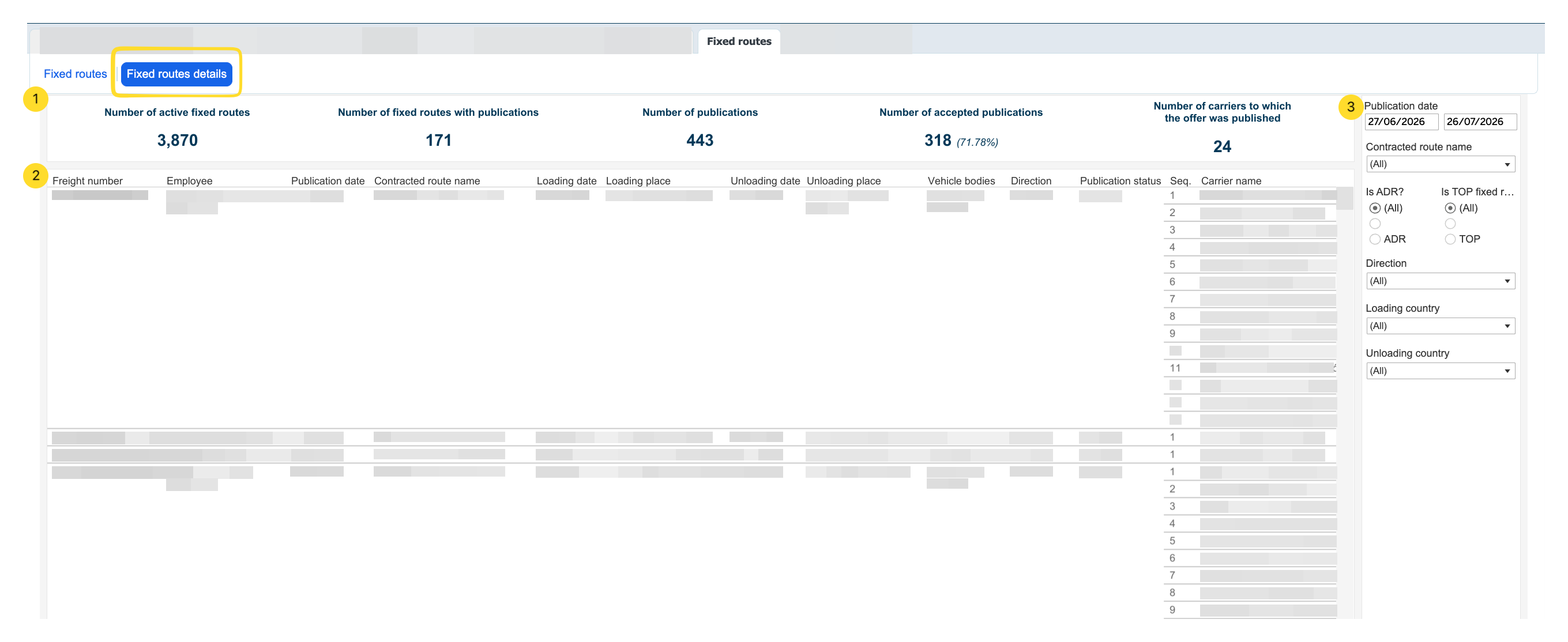
The view consists of 3 sections:
- Fixed routes overview indicators
At the top of the report you'll find 5 basic indicators that summarize the data for the selected period:- Number of active fixed routes – the number of your company's active fixed routes,
- Number of fixed routes with publications – the number of fixed routes for which offers have been published,
- Number of publications – the total number of published offers,
- Number of accepted publications – the number of accepted offers (along with the percentage rate),
- Number of carriers to which the offer was published – the number of carriers to whom offers were sent.
- Publication details table
The table presents the data of each publication, broken down into the following columns:- Freight number – the freight number,
- Employee – the employee who published the offer,
- Publication date – the publication date,
- Contracted route name – the name of the fixed route,
- Loading date / Unloading date – the loading and unloading dates,
- Loading place / Unloading place – the loading and unloading locations,
- Vehicle bodies – the type of vehicle body,
- Direction – the direction (domestic/international),
- Publication status – the publication status,
- Seq. – the sequence number within the publication sequence for a given route,
- Carrier name – the name of the carrier the offer was sent to.
- Offer publish date - the date the offer was published.
- Offer status - the offer status (e.g. accepted, no response).
- Price - the rate.
A single offer can be published to several carriers at the same time – in that case you'll see several rows in the table with the same freight number but different carriers.
- Filters
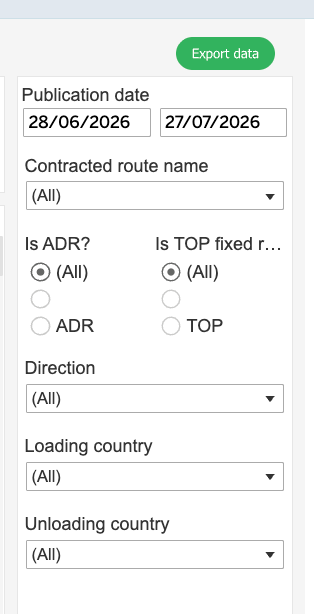
You can narrow down the scope of the data as needed using filters. You'll find them on the right side of the report.
In the filters you can select:
- Date range (Publication date) - set the period the data should come from (by publication date).
- Contracted route name – if you want to check a specific fixed route.
- Carrier name – if you want to check the statistics of a specific carrier.
- Is ADR/Is TOP – if you want to narrow down the routes to those with special requirements.
- Direction – to separate domestic routes from international ones.
- Loading/Unloading country – if you want to specify the location even further.
Just above the filters you'll find the Export data button - use it to export the table data to an Excel or CSV file.